
Energy Informatics
The Energy Informatics Group focuses on advancing the modeling and simulation of energy transition pathways, with a particular emphasis on the dynamic evolution of buildings, energy systems and urban comfort.

Introduction
By integrating intelligent control strategies with adaptive retrofitting approaches, the group investigates how buildings can continuously respond to changing usage patterns, climatic conditions, and energy demands. Our work spans the full lifecycle of the built environment—from existing infrastructure upgrades to the integration of distributed renewable energy production and energy storage systems.
The group’s research directly contributes to Switzerland’s national objectives of reducing energy consumption, expanding renewable energy—especially hydropower—and phasing out nuclear energy. Through advanced computational methods, including simulation frameworks, machine learning algorithms, and large-scale data analytics, the group develops predictive and prescriptive tools that support decision-making across multiple scales, from individual buildings to regional energy networks.
Alumni
Ongoing projects
Artificial Intelligence (AI) has become a powerful and pervasive technology in recent years, influencing numerous aspects of our daily lives. We encounter AI through recommendation algorithms in online stores, voice-activated smartphone assistants, or the widespread use of technologies like ChatGPT. However, its rapid growth and integration into society raise complex questions and concerns among the public. Public opinions on AI vary widely; while some people are enthusiastic about its potential to revolutionize industries and enable breakthroughs in fields such as medicine, others fear that AI could lead to undesirable outcomes, such as a loss of human control or privacy. These views are often shaped by media narratives and the competing interests of different stakeholders, which play a significant role in influencing both public opinion and policy decisions.
Our team of scientists and communication experts aims to enhance the understanding of AI technologies among the Swiss people, with a particular focus on teenagers and female students, to create a positive societal impact. Building on the foundations of our previous project, NewsOnAI, we will expand beyond traditional media such as newspapers and employ diverse methods, including artistic performances and interactive exhibitions. We will design these activities to be highly interactive, encouraging active participation and dialogue. Activities will include themed theater plays that explore AI’s impact on everyday life, exhibitions where participants can interact with AI tools, and workshops specifically designed for teenagers and female students to discuss AI’s future role in society. Feedback collected will include real-time audience reactions, structured questionnaires, and focus group discussions, which will be analyzed to continuously refine and adapt our engagement strategies.
Our primary audience includes Swiss citizens interested in cultural activities, particularly teenagers who are keen to follow new trends. Additionally, we are committed to addressing gender aspects by designing content and activities that specifically appeal to female students. We aim to inspire and empower young women to take on more prominent roles in shaping the digital world, acknowledging that they have historically been underrepresented in these fields. As societal attention shifts toward greater inclusion, our project will contribute to fostering a more balanced and equitable digital future.
While many individuals in our target groups may lack in-depth technical knowledge of AI, they often encounter new AI products, companies, and social issues through various media channels, including newspapers and science fiction movies. As a result, they may be aware of recent developments but also susceptible to misunderstandings and controversies related to technologies such as ChatGPT, Elon Musk's brain-chip startup, and other emerging AI applications. It is crucial to recognize that media portrayal significantly influences public opinion on AI, both positively and negatively. Media creators, even if they are not experts in AI, often produce content that captures public attention, which high-profile figures, including entrepreneurs, CEOs, and politicians, may leverage to advance their agendas. This can sometimes lead to skewed public perceptions, whether intentionally or unintentionally. Given this landscape, it is essential for AI scientists to collaborate with media creators, providing evidence-based insights to ensure accurate and balanced information is shared with the public. Our project fosters such collaboration, ensuring that both the potential and limitations of AI are clearly communicated. By sharing our findings through diverse media outlets, we aim to reach a broad audience, extending beyond Switzerland. Furthermore, our proactive engagement efforts will foster dynamic, two-way communication between scientists and the public, using interactive methods in exhibitions and theater plays to engage teenagers and female students specifically. Analyzing the feedback from these initiatives will provide invaluable insights into public perspectives on emerging technologies. This understanding will guide scientists in pursuing research directions that effectively address societal concerns, demonstrating the tangible benefits of our project for both scientific advancement and societal well-being. We anticipate that our efforts will have a multiplying social impact over time, promoting informed public discourse and a deeper understanding of AI technologies.
The aim of LIGHT is to support the comprehensive, energy-oriented transformation of existing and new urban neighbourhoods while enhancing health and well-being of citizens. As such, LIGHT will explore urban planning strategies centered around integrated solutions designed to enhance both energy performance and human well-being, with a strong emphasis on socio-economic considerations. Our focus includes integrating energy systems with blue-green infrastructure (BGI) to mitigate urban heat island (UHI) effects, optimize daylighting in densified areas, as well as reduce noise and ensure good air quality despite high urban density. By utilizing various tools and techniques, such as participatory scenario modelling and policy development tools, LIGHT thus aims to set a standard for healthy Positive Energy Districts (PEDs) which bring about high quality of life.
LIGHT establishes three Urban Living Labs (ULLs) in diverse contexts to test a range of approaches and achieve insights on replicability potential. In Kartuzy, Poland, where there is a critical need for energy-centred regeneration, integrated strategies will focus on energy renovation with particular attention to environmental sustainability and economic feasibility as well as BGI integration. In Lund, Sweden, the focus will be on densification combined with innovative energy generation, entailing carbon-neutral solutions. Within the framework of ULLs, we will also develop an innovative Virtual Urban Living Lab (vULL), involving multi-criteria analyses of various urban densification scenarios, with a particular emphasis on the impacts on health and well-being, especially in relation to noise, air quality, daylight and solar radiation. The vULL will be implemented in a neighbourhood in Innsbruck, Austria, enabling the testing of selected tools and the application of parametric design within these scenarios. All three ULLs will be crucial for testing different scenarios and identifying different feasible energy transition pathways. This approach will support key actors interested in making informed decisions. We will adopt a health and well-being perspective in achieving PEDs, enabling the integration of various objectives related to energy, spatial planning, environmental and social goals, and mobility.
These objectives range from reducing energy use and greenhouse gas (GHG) emissions, to improving the quality of life (e.g., access to daylight, air quality, lack of noise, access to green areas, mobility) to enhancing biodiversity and ecosystem services through BGI development. In this approach, health becomes the critical element for integrated planning strategies, serving as a foundation for the strategic transformation framework. In the long run, this contributes to social sustainability while promoting low healthcare costs and high productivity of urban citizens. Through a detailed analysis of synergies, trade-offs, key variables and metrics, we will identify solutions that meet multiple objectives and provide effective strategies for achieving a comprehensive urban energy transition. We will then combine the insights from these tasks to develop a set of online guidelines, digital simulation tools and metrics for PED projects across Europe. By incorporating these insights into our strategic energy-centered urban transformation framework, we will be able to pave the way for replicability of solutions across diverse urban contexts. The information, digital tools, indicators and metrics, processes and insights gained through this project will be disseminated among relevant key players and shared publicly to inspire European communities to embrace the PED transition. The project will also offer an opportunity to refine the PED framework focusing on inclusion, adaptability, and scalability. Overall, the project will demonstrate that European cities can truly lead the way as the LIGHT project will serve as a future model for an effective and inclusive transformation of cities.
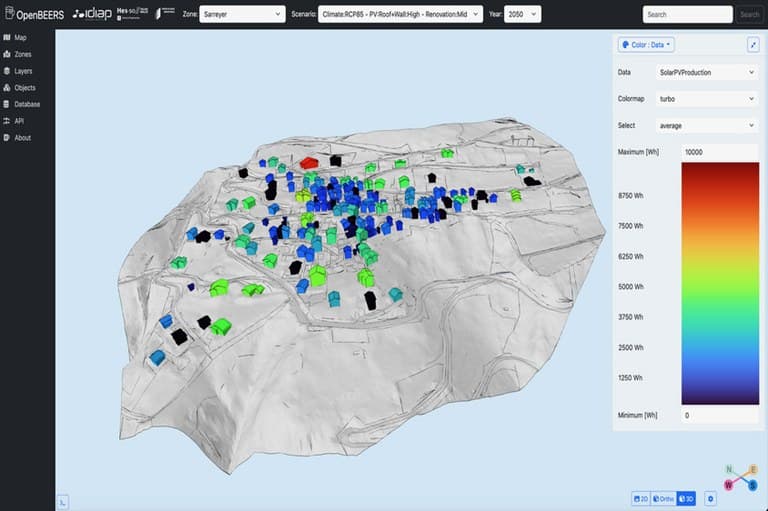
The M-POWER proposal presents an advanced framework that (i) enhances the OpenBEERS digital platform [1] by integrating a comprehensive case study of Martigny to support participatory decarbonization and urban-scale building energy simulations, and (ii) augments the platform with AI capabilities delivered through an LLM-based co-pilot.. The centerpiece of this innovation will be a secure Interaction Interface (derived through existing SDialog toolkit [2]) which will function as a governed, privacy-aware gateway connecting an autonomous (LLM-based) AI agent (co-pilot) to external simulation resources. To address the complexities of processing and querying massive, multidimensional energy data, M-POWER will support bi-modal (text, voice) and multilingual (English, German, French) human-machine interaction in natural language. A key security feature will be the separation between the AI-agent and data sources (crawled open-source data such as the Swiss Federal Building and Lodging Register [3], and pre-computed simulation indicators stored in a local database) to maximize grounding of retrieved information. The developed and integrated AI-agent will operate through standardized and logged function calls via open protocols (co-sharing raw data, or simulation results) back to the LLM in a structured, factual, and reusable way [4]. The developed M-POWER platform will deploy a bottom-up participatory approach, allowing citizens to use a natural language prompt to correct energy consumption values, or to refine physical, technical, or occupational stats regarding their homes. This collaborative dialogue will ensure that simulation models are accurately calibrated with real-world information provided directly by the community. Anonymized logging of interaction will enable refining existing functionality including user-input for possible social studies related to participatory decarbonization.
Cancer is one of the leading causes of death worldwide and in Valais, imposing a profound burden on patients, families, and the healthcare system. Altered cell metabolism is a hallmark of cancer; thus, understanding how cancer cells reprogram their metabolism is crucial for precision oncology and the successful treatment of cancer patients. However, current molecular measurements alone cannot fully explain how tumors reprogram molecular pathways to grow, survive, or resist treatment. RNA profiles are already used in clinical settings, for example, to classify tumor subtypes or to guide therapeutic decisions, e.g., through gene expression signatures. These approaches treat RNA as a descriptive snapshot. Here, we propose to take a step further by using RNA to infer a complete picture of cellular metabolism, that is, the intricate network of chemical reactions that sustain cell’s growth and survival. Genome-scale metabolic models (GEMs) provide a static, mechanistic map of cellular metabolism that RNA profiles can constrain. However, most existing approaches simply overlay expression data onto a metabolic model for a single sample at a time; they do not learn how metabolism behaves across diverse cancer types and conditions. As a result, today’s methods cannot capture the underlying regulatory processes that shape metabolic activity.
Our project introduces a fundamentally new approach. Inspired by how large language models learn patterns from vast text corpora, we propose a self-supervised learning framework that harnesses large collections of RNA-seq profiles to uncover the hidden relationships between gene expression and metabolism. The system learns directly from data, without requiring annotated examples, allowing it to capture regulatory behaviors that are not explicitly encoded in current models. Once trained, the framework can generalize across many cancer contexts and specialize to an individual patient, producing personalized metabolic profiles that may support treatment planning, subtype identification, and the discovery of metabolic vulnerabilities.
The objective of this project is to transform RNA-seq data into a functional and predictive description of cancer cell metabolism, enabling the identification of metabolic vulnerabilities relevant to precision oncology. To achieve this, we aim to learn the hidden regulatory processes underlying the network of metabolic reactions. Specifically, the project pursues the following aims: (1) to systematically assemble and curate large-scale RNA-seq datasets relevant to cancer metabolism; (2) to develop a deep learning surrogate of genome-scale metabolic models that efficiently captures metabolic behaviour; (3) to design a cross-validation framework that optimizes coherence between transcriptomic data and metabolic predictions, forming the basis of a self-supervised learning strategy; (4) to extend the surrogate into a predictive model capable of learning hidden regulatory processes that control metabolic activity; and (5) to validate the complete framework on established cancer benchmarks, with the longer-term goal of enabling patient-specific metabolic characterization to support personalized cancer treatment.
Our proposition represents a major innovation and has the potential to transform RNA-seq data (already widely available in oncology) into physiological insights, enabling scalable, automated, and clinically actionable characterization of cancer metabolism. Embedded within the strong and expanding health ecosystem of Valais and aligned with strategic priorities in AI at both the cantonal and institutional levels, the proposed project will also nucleate new, important partnerships between HES-SO, Idiap, and the hospital. Beyond its direct impact, it will also reinforce the canton’s position as a leader in AI and health innovation.
Past projects
Les réseaux de chaleur à distance ont un rôle prépondérant à jouer au niveau de l’efficience énergétique permettant la valorisation de chaleur habituellement perdue dans l’environnement. Toutefois, afin d’être rentables par rapport à d’autres sources de chaleur fossiles (gaz, mazout), les exploitants de ces réseaux doivent être en mesure de réduire les pertes dans les conduites tout en assurant un approvisionnement stable toute l’année. Ils doivent aussi prévoir des possibilités d’extension pour utiliser la puissance libérée par les efforts d’efficience énergétique demandés aux bâtiments. Ils doivent ainsi pouvoir optimiser dynamiquement les paramètres de contrôle de leurs réseaux et en simuler les extensions comme fonction de la demande et de la production locale des bâtiments. Le recours à l’intelligence artificielle (le cœur de cette démarche) devra permettre d’effectuer une simulation instantanée en remplacement de la simulation physique explicite des réseaux. Il s’agit de développer un logiciel d’aide à la décision pour les contracteurs avant de procéder à de lourds investissements. Dans les faits, Eguzki va permettre d’une part, d’optimiser l’architecture des réseaux en diminuant les coûts d’investissement et d’autre part d’optimiser l’exploitation et de diminuer les pertes énergétiques du réseau. Une demande de subvention a été faites à Innosuisse sans succès, en raison des objectifs de rentabilité attendus non atteignable par Eguzki.
Data is central for energy research and analysis. Unfortunately, energy data is often difficult to find, mixed in different repositories, and generally fragmented. This results in a lack of efficiency for research and energy transition management. EnerMaps aims to improve data availability, data quality, and data management for industry (in particular renewable technology industry), energy planners, energy utilities, energy managers, energy consultants, public administration officers specialised in the energy sector and policy decision makers as well as social innovation experts and data providers, applying FAIR principles. To this end, we focus on three axes: a) The creation of two tools working in conjunction: a scientific community dashboard providing a critical mass of energy datasets in one common tool, and a data management tool providing a quality-check selection of crucial data with an integrated visualization and calculation modules. Both tools will be freely accessible to all users. b) Scientific communication: we increase current capacities of publicly-financed R&I projects to communicate their newly created datasets through enrichment and promotion activities. The aim is to increase the probability of seeing these datasets reused. c) Capacity building on data management: an extensive set of formation is organized for lead-user representatives. The use of action-learning techniques and the application of a “train the trainer” approach ensures the efficiency of the training programs. The project collaborates actively with European-wide data management initiatives such as the European Open Science Cloud Initiative and integrates actively its future users into the development of the different tools to insure their usefulness.
D'une part, le plan directeur du Canton table sur une augmentation de 50% de la population pour 2050 et d'autre part, la loi sur l'aménagement du territoire (LAT) impose un principe de densification urbaine vers l'intérieur (de la ville). En tenant compte du réchauffement climatique, l'accentuation des fortes chaleurs en ville (îlots de chaleur urbains ou ICU) est une évidence. La ville de Fribourg souhaite, par ce projet, se munir d'un outil décisionnel et communicationnel pour anticiper et sensibiliser aux conséquences du réchauffement climatique sur le confort urbain et la santé humaine, sur la planification urbaine (nature en ville) et sur la consommation et production énergétique renouvelable.
Mobi-Let creates a scalable and efficient battery exchange network for E-scooters on the basis of circular economy. They solve the pain of modern city and periphery transport by enhancing individual mobility with minimal impact on the environment. Mobi-Let connects users of soft mobility to renewable energy providers and addresses their concern about cost, range and battery life. Their approach is to promote local corner shops and SMEs by turning them into battery exchange hubs: Customer reserves a battery ahead of time, shows up with his empty battery and leaves in a few minutes with a charged battery, ready for the road. The role of Idiap on this project is on the topic of battery network management. Phase 1: How can we estimate the remaining range of a battery by taking into account the parameters that may affect the battery performance such as user data, battery data, outside temperature? Phase 2: How can we determine the best route by taking into account the above data as well as user's destination and available batteries in the network? To achieve the above, we will have to develop a hardware layer to make the batteries connected, our platform will collect usage data and then turn data to smart data for better service to clients and community. Basically we aim to create a better user experience than Tesla. We expect the technology to be applicable to other types of vehicles in the future (E-bikes, light cars).