
Neuro-symbolic AI
The Neuro-symbolic AI Group develops models which are capable of complex, controlled, transparent, data-efficient and safe reasoning.

Introduction
The groups operates at the interface between neural and symbolic AI methods aiming to enable the next generation of controlled explainable, data-efficient and safe AI systems. Our research investigates how the combination of latent and explicit data representation paradigms can deliver better learning and reasoning over data.
Neuro-symbolic AI methods are critical to enable the application of AI methods in industrial settings, facilitating the development of models which are transparent, safe and that can generalize over small and heterogeneous datasets.
Our current research areas include:

Current group members
Alumni
Ongoing projects
In this collaboration project, we extend the abilities of currently existing large language models (LLMs) to coordinate an end-to-end simulation-based engineering and design experimental process from experimental design, to instantiation, results interpretation, and experimental adaptation. We target to build the basis for an LLM-based CAE model which targets both the communication impedance across different representation modalities and upscaling of the design exploration.
With the introduction of the transformer architecture Vaswani et al. (2017) and its recent evolution into Large Language Models (LLMs), a number of approaches developed in Natural Language Processing (NLP) reached a level of performance that makes them ready (or almost ready) for deployment in real-world settings. Many of these applications are evolving from a text classification perspective (e.g. sentiment analysis, information extraction) to complex reasoning tasks including in complex domains of discourse. Some of these domains of discourse, such as political, ethical and legal reasoning, requires an interpretation model which not only models processes of inference, both formal and material, but also requires the acknowledgment and integration of multiple assumed perspectives and value systems.
The dominant paradigm for the construction of these systems involves the notion of a human-grounded feedback, the use of annotations, instructions or post-hoc validation for the training or evaluation of these models. This paradigm, when applied to complex and multi-perspective domains, bring the inherent risk of introducing severe subjective biases into these models. As generative language models march towards widespread application, developing new methodologies for integrating multi-perspective reasoning capabilities into these models becomes a matter of strategic societal importance.
This project focuses on the development of new conceptual resources and methods to support the development of Natural Language Inference (NLI) models which deliver multi-perspective reasoning. To achieve this ambition, it is conceptualized across four main pillars: (i) a novel conception of multi-perspective reasoning based on inferentialism (MPR), (ii) a novel conceptual understanding of perspectival rationality inspired by the philosophy of science, (iii) the development of novel mechanisms for controlling LLMs in order to deliver MPR and (iv) new evaluation methodologies for MPR models.
In NLP, there has been a long-standing orthodoxy of unifying disagreeing perspectives – be it in the creation of a training dataset or in the evaluation of the output of LLMs – into one single ground truth, usually by majority vote. More recently, however, researchers have started to explore ways of appreciating and exploiting the plurality of perspectives (what we call perspectivality) that can become visible in the context of challenging tasks such as the computational assessment of argument quality.
However, the basic issue with this positive conception of perspectivality is that, to this day, it suffers from both a theoretical and a practical deficiency. On the theoretical side, it is not clear (i) how exactly to understand the notion of a perspective, including basic aspects such as the question of what such perspectives are perspectives of, how to give an exact account of such perspectives, and what makes such perspectives rational positions in the space of reasons (rather than simple aberrations or noise). M-Rational will develop conceptual answer to these basic questions. Our project aims to chart new terrain, neither forcing everything into the Procrustean bed of a single unified ground truth, nor collapsing into a debilitating “anything goes” relativism. On the practical side, M-Rational will contribute to evolving the state of the art in NLI and argumentation reasoning by shaping the sub-theme of multi-perspective argumentation reasoning, i.e. models which can interpret and critically augment arguments, mapping representative stances, eliciting underlying premises (assumed facts, definitions) and maximize logical validity. Combining with the philosophical part, the project will also modify the very notion of what it means to make progress at argument reasoning in multi-perspectival settings by reconceiving the goal of the task as such.
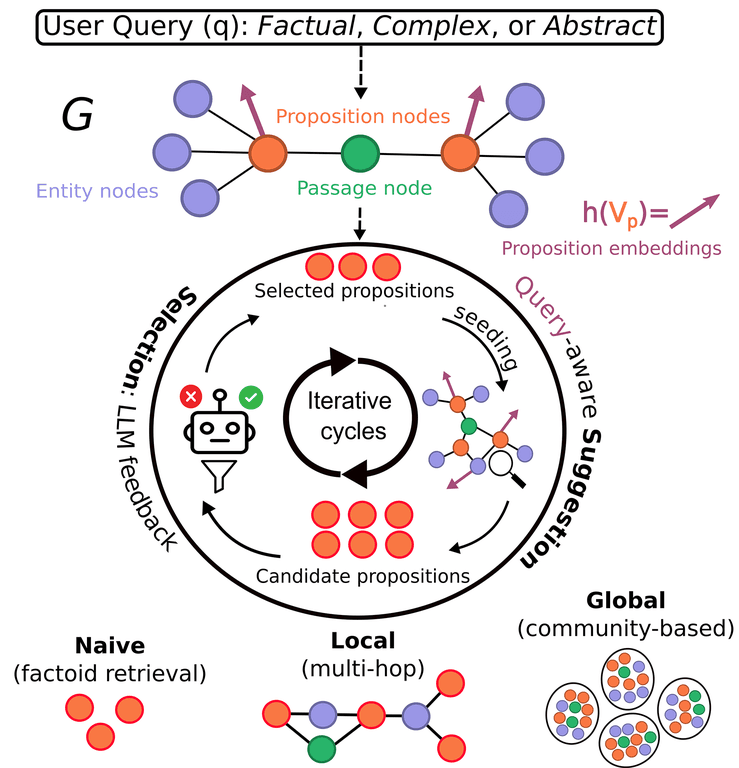
Large Language Models (LLMs) have emerged as universal models for addressing language understanding and inference tasks. However, In order to operate factually and rigorously, these models need to be provided with a relevant associated factual context and to reason systematically and controllably over the retrieved evidence. Retrieval Augmented Generation (RAG) became the complementary architectural mechanism which enables LLMs to operate factually, in which a retrieval step delivers the associated facts relevant within a specific task. However, there is a disconnect between the performance of retrieval models, which are grounded on textual embeddings (comparatively lower semantic granularity and performance) and the capacity of LLMs to interpret and operate over these results. As a result, LLMs are currently bound to the comparatively lower performance of RAGs and to their ability to critically reason over these facts.
RATIONAL aims to develop new methods to support LLMs to perform factual and controlled evidence-based Natural Language Inference (NLI). At the centre of its methodological contributions, RATIONAL will develop:
(i) new evidence retrieval models which can support crossing the semantic gap between abstract query intents and concrete evidence, by developing novel query augmentation paradigms, sentence embedding methods and contextual retrieval generation methods specialised for crossing the intent-evidence abstraction gap.
(ii) new evidence-based Natural Language Inference (NLI) models which are capable of integrating and reasoning over the retrieved facts in a controllable and critical manner.
These new NLI methods will concentrate on the integration of formal epistemological mechanisms and joint quantitative and qualitative reasoning methods to support evidence-based reasoning.
Past projects
Background and Motivation. The HEP-VS is a key academic institution for the education of children, adolescents, and young adults in Valais. The potential transformation that AI will enable in education is unprecedented, as AI technologies open opportunities but also involve significant risks. To incorporate AI as part of present and future educational programs, and effectively serve the multiple actors in the cantonal educational ecosystem – including HEPVS students, HEPVS faculty and instructors, teachers and students in public schools - a systematic institutional approach to acquire AI literacy (knowledge, skills, and abilities needed to effectively interact with AI technologies) is paramount.
In parallel, Idiap, as a prominent institution in AI research, has been committed to inventing core advanced technologies, but also to design methods to facilitate the widespread understanding and use of these technologies, aligned with its “AI for Society’ mission. In particular, Idiap has recently developed a conceptual framework for AI Literacy, based on twelve competencies that span a range of needed knowledge, skills, and abilities, and focused on last-generation Generative AI technologies.
HEP-VS and Idiap started discussions in 2024 to envision a long-term collaboration as key cantonal institutions in education and AI, with the ambitious objective of devising a systematic approach to support the HEP-VS reflect upon, acquire, and spread AI Literacy, based upon the HEP-VS’s specific needs and priorities, and contextualized with different actors of the cantonal educational ecosystem.
Objective and methodology. The proposed one-year project presented here represents both a launching pad and a proof-of-concept of the Idiap/HEP-VS long-term collaboration. We will develop the systematic approach based on the twelve-competency Generative AI Literacy Framework and an “AI Literacy & Literacy with AI” approach that will integrate pedagogical, participatory, and technological methods. The project includes specific research activities to achieve 3 research objectives: (O1) assessment of the state of AI literacy for a population of HEP-VS students; (O2) co-design of customized educational modules for key components of the Generative AI Literacy Framework; and (O3) prototyping and initial testing of such modules. Importantly, some of the prototyping will use state-of-the-art AI as a tool to support AI literacy acquisition and assessment, thus integrating the expertise of Idiap in NLP and social computing, while HEP-VS will contribute to the research framework through its expertise, particularly in the areas of methodological design (educational sciences and disciplinary didactics), pedagogical design and experimentation (digital learning engineering and pedagogical facilitation), as well as in the analysis of the effectiveness and efficiency of classroom interventions and the evaluation of their implementation (statistics, cognitive psychology, epistemology of scientific inquiry, etc.). The conceptual framework proposed by Idiap for Gen AI literacy is directly aligned with the issue of effectiveness (learning outcomes) and efficiency (resource optimization) in the use of AI for learning across distinct disciplinary domains.
Expected outcomes and impact. As research outputs, the project will produce an assessment of the state of AI Literacy of a sample of HEP-VS students; educational resources for Generative AI Literacy (both consolidated from existing ones, as well as novel resources developed in the project); and joint scientific publications. Furthermore, the impact beyond concrete research outputs includes the consolidation of the bi-institutional partnership about this important priority theme for both HEP-VS and Idiap, and the establishment of first joint scientific results, which are needed to apply for larger research and educational projects.
Bloom's Strategic Anticipation Platform supports companies' strategic decision-makers with unique data-driven insights from social media. The incorporation of SOTA NLP and causal predictive models will significantly increase Bloom's value proposition and boost the adoption of our platform.
The ValViser project aims to transform fleet management, starting with waste collection, by developing an AI-powered data interpretation solution leveraging my expertise in heavy machinery optimization and interpretable AI systems. Building on recent breakthroughs in Large Language Models (LLMs), the solution will generate actionable insights from fleet telematics data, addressing utilization challenges.
This project builds on my AI research focused on enhancing decision-making through reasoning capabilities, including developing LLM-based knowledge synthesis frameworks and deploying machine learning models. My prior research and industry experience in optimizing heavy vehicle operations, including my doctoral dissertation, led to an 8% reduction in fuel consumption for garbage trucks, reduced mechanism wear, and substantial cost savings.
Current fleet management solutions excel in data collection but lack specific recommendations to improve operational efficiency. ValViser will bridge this gap by delivering actionable insights to address challenges like reducing fuel consumption, crew overtime or vehicle downtime. ValViser democratizes advanced data analytics, allowing managers to interact in natural language and make informed decisions without specialized expertise.
Waste collection involves balancing fuel efficiency, crew safety, route optimization, and maintenance, which are largely similar across Europe, making ValViser widely applicable. Unlike traditional telematics, my AI-based product will interpret these factors and provide targeted recommendations. By simplifying interaction through natural language processing, the users can efficiently query the system and receive tailored advice.
The project targets key cost drivers—fuel, crew, and maintenance—that account for over 80% of fleet expenses (>20000 CHF/mth/truck). ValViser’s subscription model optimizes fuel efficiency, reduces crew overtime, and minimizes maintenance downtime, boosting profitability. Market analysis shows significant potential for industry-wide cost savings and sustainable waste management.
Implementation will involve collaborating with industry partners to leverage their infrastructure for seamless integration. Initial proof-of-concept trials will develop an AI interpreter that adapts to existing APIs and a plugin solution for user interfaces to process and visualize vehicle metrics. The goal is to integrate this plugin into at least one partner's platform, enabling users to gain insights from real-time fleet data. Commercialization will scale the solution, targeting the broader European waste management market and related sectors.
Through sustainable optimization of waste collection, this project supports SDGs by promoting efficient resource use, reducing CO2 emissions, and enhancing urban safety. ValViser offers a scalable, innovative approach to fleet management, making waste collection more efficient, actionable, and sustainable.